
What moves
an excavator?
Hydraulic travel motors, final drives and slew motors for tracked excavators.
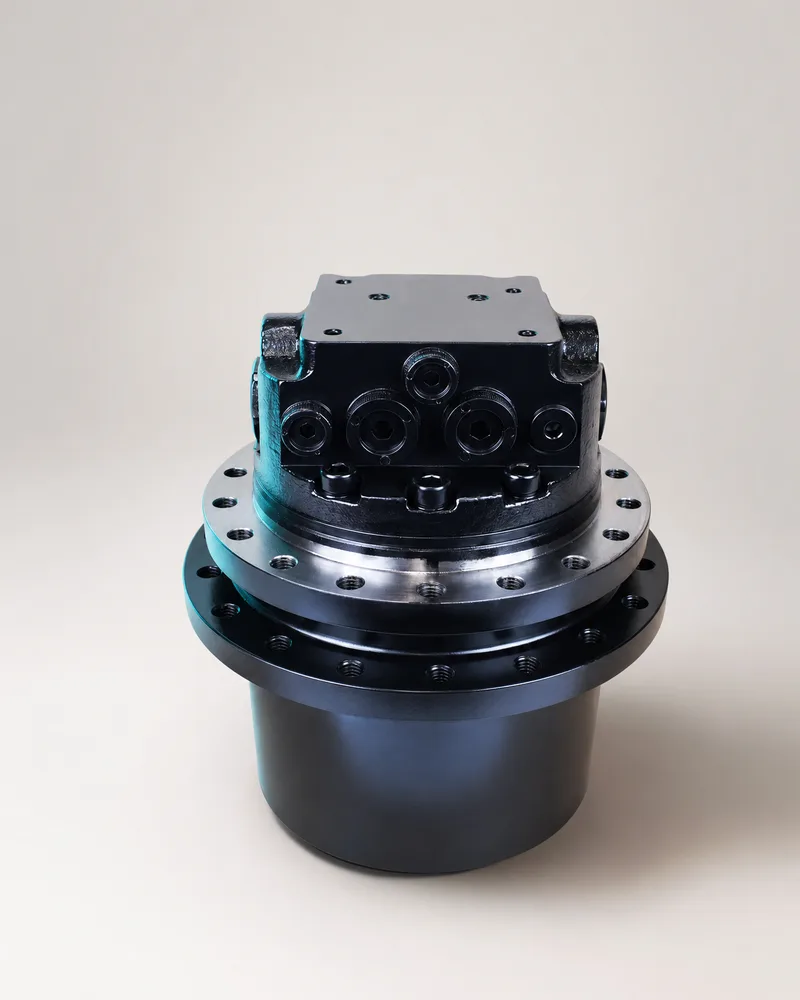
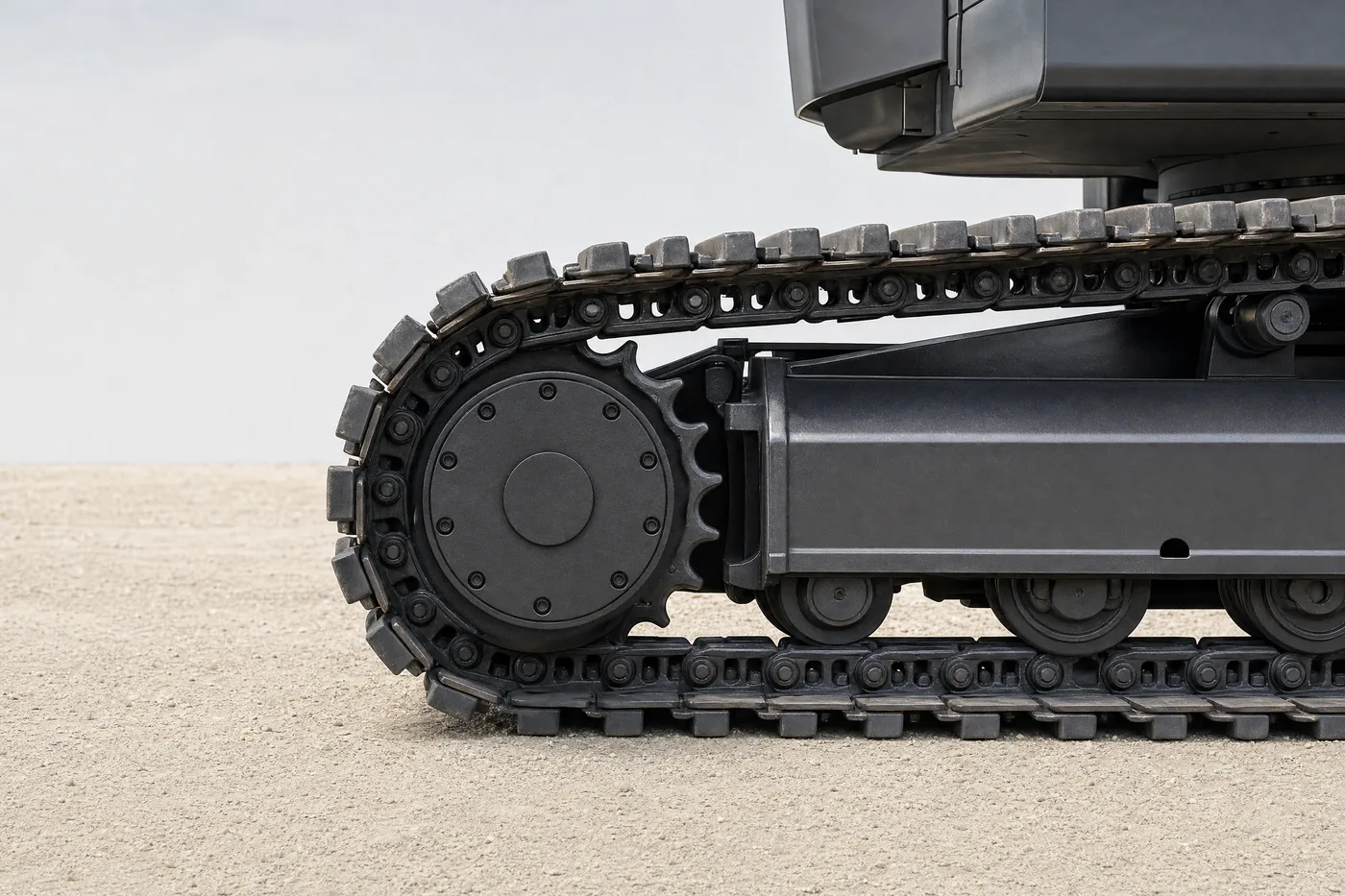
The travel drive on its own.
- I have a part numberYou can read a reference on the unit or in a document.
- I have a photoPhotos of the unit, the plate or the mounting faces.
- I need help identifying the driveNo readable plate: measure the mounting faces.
Travel drives
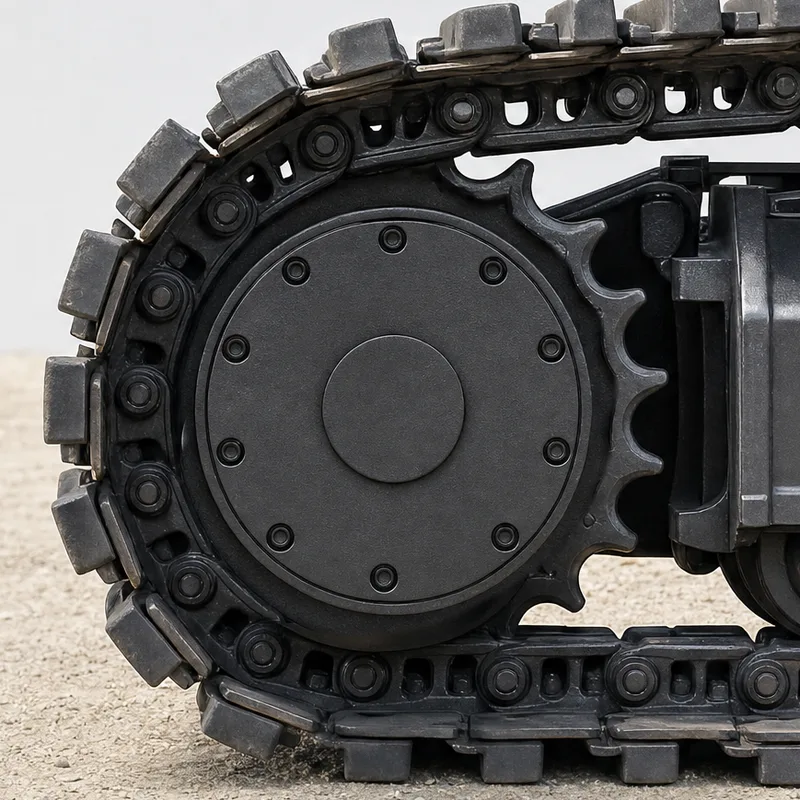
A travel drive turns the sprocket. The sprocket moves the track. The machine drives.
On a tracked excavator each track has its own drive. One side can turn forward while the other turns back. This is how the machine steers, and how it turns on the spot.
A travel drive usually has a hydraulic motor and a reduction gearbox, most often planetary. The motor makes rotation from oil flow. The gearbox lowers the speed and raises the torque at the sprocket.

Six travel drives side by side. Housing size and colour differ. Part numbers and tonnage ranges are added after identification.
Inside a final drive
Hydraulic motor, planetary reducer, output flange and drive sprocket on one axis. Open the drive on the machine and turn it by hand.
 Drag to turn the input shaft
Hydraulic motor
Oil flow turns the motor shaft. Flow sets the speed, pressure sets the torque.
The motor turns the input shaft with the sun gear. Sun gear: input, 12 teeth.
Planetary reducer
The planetary stage lowers the speed and raises the torque before it reaches the housing.
Three planet gears turn on pins in the carrier, 18 teeth each. The carrier is fixed to the frame spindle.
Output flange
The output flange turns with the housing. The sprocket is bolted to it.
Ring gear (internal teeth, 48): part of the rotating housing, output.
Drive sprocket
The sprocket teeth drive the track. The track is shown only as context.
Output flange and sprocket: bolted to the rotating housing.
- Sun gear, input
- 0.0 turns
- Housing and sprocket, output
- 0.00 turns, opposite way
Schematic of the working principle. Not a drawing of a specific TRK product. Sun gear 12 teeth, planet gears 18, ring gear 48: four turns in, one turn out. Tooth counts are illustration values.
Slew drives
The tracks stay still. The upper structure turns.
A slew drive turns the cab, boom and counterweight over the undercarriage. A slew motor drives a reduction gearbox. A pinion on the gearbox output meshes with the ring gear of the slew bearing.
- Ring gear: INTERNAL teeth point inward, fixed to the undercarriage (72 teeth).
- Swing pinion: inside the ring, 12 teeth, same module (common pitch).
- Upper structure with the swing motor and reducer: rotates about the vertical axis. The dashed arc is the path of the counterweight.
- Undercarriage and tracks: stationary.
Frames
Frame 1 · Upper structure swung to the left limit. The ring is fixed; the pinion has rolled inside it. Frame 2 · Centre position. Undercarriage and ring gear have not moved. Frame 3 · Swung to the right limit. A pinion tooth is in a ring gap in every frame.
Also called a swing motor or swing drive.
Field guides
Seven short guides. Each starts with the answer.
- Travel motor, gearbox or complete final drive?They are three scopes of supply for one drive, so name which one you need.
- No readable ID plate? Identify the two mounting faces.Photograph and measure the frame side and the sprocket side before you write to us.
- What changes between low and high travel speed?On a two-displacement motor, smaller displacement gives more speed and less torque at the same flow and pressure.
- Why does an excavator pull to one side?Write down what you see first; the cause can be in the undercarriage, the hydraulics or the drive.
- Gear oil and hydraulic oil: which part uses which?The motor runs on hydraulic oil from the machine; the gearbox has its own oil space with gear oil.
- Travel or slew: which drive do you need?If the machine drives on its tracks, it is a travel drive. If the upper structure turns, it is a slew drive.
- What does a case drain do?It lets oil that leaks inside the motor housing flow back to the tank.
Short answers
What if the plate is unreadable?
Photograph both mounting faces and measure what you can. See the field guide.
Can I send a part number with leading zeros?
Yes. We keep it exactly as you type it.
Is a travel drive the same as a slew drive?
No. A travel drive moves the track. A slew drive turns the upper structure.
Do you supply tracks, rollers or sprockets?
No. These are KERTRACK products.
Can you confirm that a drive fits my machine?
A fit needs data on the exact variant. We check before we confirm.
Next step
Identify my drive
Send a part number, a photo or the machine data. Skip what you do not know.